

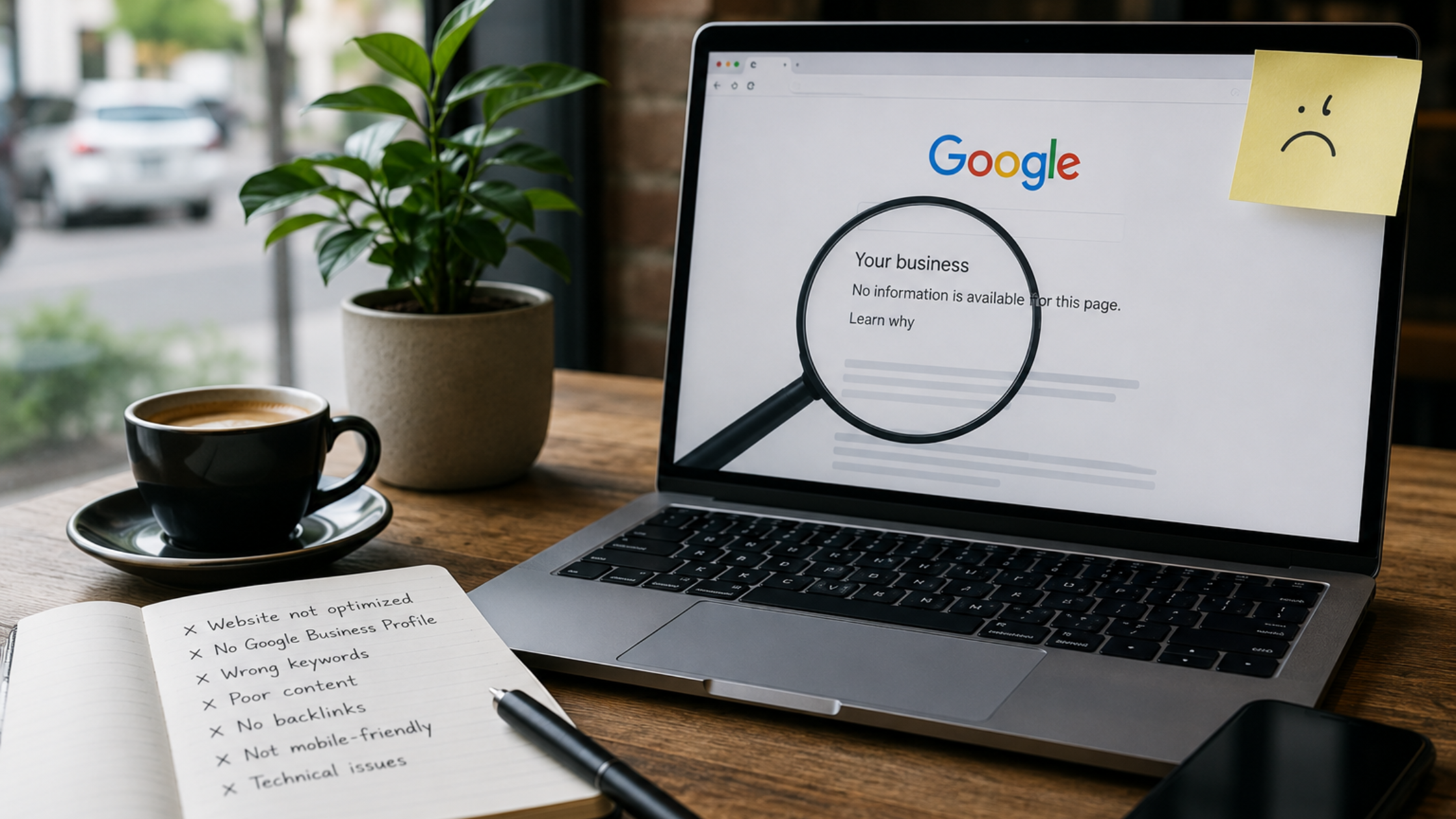
Why Isn’t My Business Showing Up on Google? The Most Common SEO Mistakes
You launched your website. You invested time in writing content, uploading images, listing your services, and making sure everything looked professional. You shared the website with friends, added it to your social media profiles, and even printed it on your business cards.
A few weeks later, you opened Google, typed in the service you offer, and expected to find your business somewhere in the search results. Instead, your competitors appeared. You tried another search using different keywords. Still nothing.
You searched page after page, convinced your website had somehow disappeared from the internet. Eventually, frustration set in, and you began asking the same question thousands of business owners ask every day:
“Why isn’t my business showing up on Google?”
The truth is, this is one of the most common problems businesses face after launching a website. Many people assume that once a website is live, Google will automatically start sending visitors. Unfortunately, that’s not how search engines work.
Google doesn’t rank websites simply because they exist. It ranks websites that provide value, offer a great user experience, answer searchers’ questions, and demonstrate trust and authority over time. Every day, Google processes billions of searches and chooses from millions of websites to determine which pages deserve to appear first. Your website is competing with businesses that may have spent years improving their online presence, creating content, earning backlinks, and refining their SEO strategy.
The good news is that if your business isn’t showing up today, it doesn’t mean it never will. In most cases, poor visibility comes down to a handful of common SEO mistakes that can be identified and improved. Some are technical, some relate to content, and others stem from simply misunderstanding how search engines evaluate websites. Before looking at those mistakes, it’s important to understand what actually happens when someone searches on Google.
How Does Google Decide Which Websites to Show?
Whenever someone searches for a product or service, Google’s goal is to provide the most helpful answer possible.
To do that, Google first discovers websites through a process called crawling. It sends automated bots, often called spiders or crawlers, to explore webpages and follow links across the internet. Once those pages are found, Google stores them in its index, which is essentially a massive database of websites.
When a user performs a search, Google doesn’t search the internet in real time. Instead, it searches its index and evaluates thousands of ranking signals to decide which pages are most relevant. These signals include the quality of your content, website speed, mobile usability, keyword relevance, backlinks, user experience, location, and many other factors.
This means that simply owning a website is not enough. Your website needs to be discoverable, technically sound, useful to visitors, and consistently maintained if you want Google to consider it a valuable result. Let’s look at the mistakes that often prevent businesses from reaching that point.
1. Your Website Hasn’t Been Indexed by Google
One of the simplest yet most overlooked reasons businesses fail to appear on Google is that their website hasn’t actually been indexed. Think of Google’s index as a giant digital library. If your website isn’t included in that library, Google has nothing to display when someone searches for your business or services.
This often happens with newly launched websites, but it can also affect older websites if technical settings accidentally block search engines. For example, imagine a construction company launches a brand new website with detailed service pages, project galleries, and contact information. The design looks excellent, but months later they still receive almost no organic traffic.
After checking Google Search Console, they discover that their website was never properly submitted for indexing, and several important pages were marked with a “noindex” directive during development. Google wasn’t ignoring the website, it simply wasn’t allowed to include it in search results. Fortunately, this is usually an easy problem to fix.
Submitting an XML sitemap, checking indexing status through Google Search Console, and removing accidental crawl restrictions can help Google discover your content correctly. Many businesses spend money on redesigning websites when the real issue is that Google never had access to the pages in the first place.
2. You’re Targeting Keywords Nobody Searches For
A beautiful website won’t generate traffic if it isn’t speaking the same language as your customers. Many businesses write website content based on how they describe their services internally rather than how potential customers actually search online. For example, a software company may proudly describe itself as a provider of “digital transformation ecosystems.” While that phrase sounds impressive, very few business owners are opening Google and searching for it.
Instead, they’re typing queries like:
- CRM software for small businesses
- Business automation software
- Inventory management system
- ERP software for manufacturers
The difference may seem small, but it dramatically affects visibility. Search engine optimization begins with understanding search intent. Ask yourself: if someone has never heard of your company, what words would they use to find your services?
- A law firm should optimize for legal services people actually search for.
- A restaurant should focus on cuisine, location, and dining experiences.
- A web development company should target phrases like “website development company,” “eCommerce website development,” or “custom web application development” instead of vague marketing language.
Keyword research isn’t about stuffing as many keywords as possible into a page. It’s about understanding your audience and creating content around the questions and problems they are already searching for. The closer your content matches user intent, the more likely Google is to consider it relevant.
3. Your Website Doesn’t Have Enough Helpful Content
One of the biggest misconceptions about websites is that a few pages are enough to rank well. Many businesses launch a website with a homepage, an About page, a Services page, and a Contact page. While those pages are important, they rarely provide enough information for Google to understand your expertise. Google wants to recommend websites that genuinely help users.
Imagine two accounting firms.
The first firm has a simple website listing its services in a few paragraphs.
The second firm offers detailed explanations of tax planning, business registration, GST filing, financial audits, frequently asked questions, case studies, and educational blog articles that answer common client concerns.
- Which website appears more useful?
- Which one demonstrates expertise?
- Which one is more likely to keep visitors engaged?
The answer is obvious.
Helpful content doesn’t just improve SEO, it builds trust. When businesses consistently publish informative articles, practical guides, industry insights, and answers to common questions, they create more opportunities to appear in search results. Every quality page becomes another entry point for potential customers. Content marketing and SEO work together. The more useful information your website provides, the more opportunities Google has to match your pages with relevant searches.
4. Your Website Is Too Slow
Speed is no longer just a convenience. It is a ranking factor and an important part of user experience. Think about your own browsing habits. When a website takes several seconds to load, how often do you wait patiently? Most people don’t. They leave and choose another website.
Google understands this behavior. If visitors consistently abandon slow websites, it signals that the experience isn’t meeting expectations.
Website speed can be affected by oversized images, poor hosting, unnecessary plugins, inefficient code, or unoptimized scripts. These issues are often invisible to business owners because the website appears to function normally, even though it loads much more slowly than it should.
Imagine an online furniture store advertising a seasonal sale. A customer clicks the advertisement, but the homepage takes eight seconds to load because high resolution images haven’t been optimized. Before the products even appear, the customer closes the page and visits another retailer.
- The marketing campaign successfully generated a visitor.
- The website lost the customer.
Improving speed is one of the highest-impact SEO improvements a business can make. Compressing images, enabling browser caching, minimizing unnecessary scripts, using quality hosting, and regularly monitoring Core Web Vitals can significantly improve both rankings and user satisfaction.
Fast websites don’t just perform better on Google. They create better first impressions and keep visitors engaged long enough to become customers.
5. Your Google Business Profile Is Incomplete or Poorly Optimized
If your business serves customers in a specific city or region, your Google Business Profile is just as important as your website.
Many business owners spend months improving their websites while completely overlooking their Google Business Profile. They create an account, verify the business, add a phone number, and assume the job is done. In reality, Google uses this profile to understand who you are, where you are located, and how relevant your business is for local searches.
Imagine someone searches for “web development company near me” or “best café in Rajkot.” Before the traditional website results even appear, Google often displays the Local Pack, a section featuring businesses with maps, reviews, contact information, photos, and directions. If your Google Business Profile is incomplete or inactive, you are far less likely to appear in these results.
A common example is a dental clinic that has a professional website but never updates its Google Business Profile. The clinic has no recent photos, very few reviews, outdated opening hours, and an incomplete business description. Meanwhile, a nearby competitor regularly uploads photos, responds to customer reviews, updates business information, and posts helpful updates. Even if both clinics provide excellent services, Google has more confidence in recommending the business with the stronger local presence.
Optimizing your Google Business Profile is not complicated, but it requires consistency. Ensure your business name, address, and phone number are accurate across every platform. Choose the correct business category, write a clear business description, upload high-quality images, encourage genuine customer reviews, and keep your profile updated whenever something changes.
Local SEO is about helping Google understand that your business is active, trustworthy, and relevant to people searching in your area.
6. Your Website Isn’t Mobile Friendly
More than half of all Google searches now happen on mobile devices. That means your website is often being judged on how it performs on a smartphone rather than on a desktop computer. If visitors have to zoom in to read text, struggle to click buttons, or wait for pages to adjust to their screen size, they are likely to leave before exploring your services.
Google recognizes this behavior. In fact, Google primarily uses the mobile version of your website when evaluating rankings through a process known as mobile first indexing. If your mobile experience is poor, your search performance can suffer even if your desktop website looks perfect.
Consider a local restaurant with an attractive desktop website. The menu looks great on a laptop, but on a mobile phone the text overlaps, images don’t resize correctly, and the “Book a Table” button is difficult to tap. A potential customer searching for a place to eat may simply return to Google and choose another restaurant whose website is easier to navigate.
The restaurant didn’t lose the customers because of the food. It lost the customer because of the experience. A mobile friendly website should adapt naturally to different screen sizes, maintain fast loading speeds, provide readable text, and make important actions like calling, messaging, or filling out a contact form simple and intuitive.
Today, responsive design isn’t a premium feature. It’s the minimum standard users and search engines expect.
7. You’re Ignoring Technical SEO
Technical SEO sounds intimidating, but its purpose is straightforward. It ensures that search engines can properly understand, crawl, and navigate your website. Think of it like building a beautiful office building. Even if the interior looks amazing, people will struggle to visit if the entrance is blocked, the elevators don’t work, or the address doesn’t exist. The same principle applies to websites.
Technical SEO includes elements such as clean website architecture, secure HTTPS connections, XML sitemaps, structured data, canonical tags, broken link management, page indexing, and proper internal linking. While visitors may never notice these details, Google certainly does.
For example, an eCommerce store may accidentally create hundreds of duplicate product pages because of filtering options. Google becomes confused about which page should rank, causing search visibility to decline. Another business might redesign its website without setting up redirects from old URLs to new ones. As a result, visitors and search engines encounter broken pages instead of useful content. These issues often go unnoticed because they don’t dramatically change how the website looks. However, they significantly affect how Google evaluates the site.
Regular technical SEO audits help identify problems before they become major obstacles. Businesses don’t need to become technical experts themselves, but they should ensure their website is maintained by people who understand how search engines work behind the scenes. A technically healthy website gives Google confidence that it can crawl and understand your content efficiently.
8. Your Website Doesn’t Have Enough Trust Signals
Google’s goal is to recommend businesses that users can trust. That’s why trust plays a significant role in modern SEO. Imagine searching for a company that offers financial consulting. You visit their website and notice there are no client testimonials, no company information, no team profiles, no contact address, no portfolio, and no case studies. Although the design looks attractive, something feels incomplete.
Now imagine another company. Their website includes verified customer reviews, detailed service pages, completed projects, client success stories, awards, certifications, frequently asked questions, and clear contact information.
Which business feels more trustworthy? Google asks similar questions. Trust signals help both search engines and visitors understand that your business is genuine, experienced, and capable of delivering what it promises.
Some of the strongest trust signals include:
- Genuine customer reviews
- Case studies
- Portfolio projects
- Client testimonials
- Secure HTTPS connection
- Detailed About Us page
- Team information
- Industry certifications
- Contact information
- Privacy policy and legal pages
These elements may not directly increase rankings overnight, but together they improve user confidence, increase engagement, and reduce bounce rates, all of which contribute to better long term SEO performance. Many businesses underestimate how much credibility influences search success. People don’t simply buy products. They buy confidence. And Google wants to recommend businesses that inspire that confidence.
SEO Is About Building Value, Not Outsmarting Google
One of the biggest misconceptions surrounding SEO is that it involves finding shortcuts to trick Google into ranking a website higher. Years ago, businesses could sometimes achieve quick results by stuffing pages with keywords, buying hundreds of low-quality backlinks, or publishing thin content simply to increase page count.
Those tactics no longer work consistently. Google’s algorithms have become significantly more sophisticated. Instead of rewarding websites that manipulate rankings, they increasingly reward websites that genuinely help users solve problems.
This means successful SEO is no longer about chasing loopholes. It’s about building a better website. Every improvement you make, whether it’s publishing useful content, improving loading speed, optimizing for mobile devices, earning authentic reviews, or creating a better user experience, helps both your visitors and your search visibility. When you focus on creating value for users, SEO becomes a natural outcome rather than the sole objective.
9. You’re Expecting Results Too Quickly
One of the most common SEO mistakes isn’t technical at all, it’s expecting Google rankings to improve overnight. Many businesses launch a website, publish a few service pages, and assume they’ll appear on the first page of Google within a few weeks. When that doesn’t happen, they conclude that SEO doesn’t work and stop investing in it altogether.
The reality is very different. SEO is a long-term strategy because Google needs time to discover, understand, and evaluate your website. It also needs to compare your content against competitors who may have been publishing articles, earning backlinks, and improving their websites for years.
Think of SEO like building a reputation. If a new café opens today, it doesn’t immediately become the most popular café in the city. It earns that reputation over time by serving good food, providing excellent customer service, collecting positive reviews, and encouraging people to recommend it to others.
The same principle applies to websites. Google wants evidence that your business is active, trustworthy, and consistently providing value before rewarding it with higher rankings. For example, imagine two plumbing companies.
The first company publishes one blog article, makes a few keyword changes, and expects immediate results. After a month without significant traffic, they abandon SEO altogether.
The second company takes a different approach. They regularly publish helpful articles answering common customer questions, optimize their service pages, improve website speed, collect Google reviews, and keep their Google Business Profile updated. Six months later, they began ranking for multiple local search terms. A year later, organic search has become one of their biggest sources of enquiries.
The difference wasn’t luck. It was consistent.
For most businesses, noticeable SEO improvements begin to appear within three to six months, while more competitive industries may require six to twelve months or longer. The exact timeline depends on factors such as competition, website quality, domain authority, content strategy, and ongoing optimization. Businesses that treat SEO as an ongoing investment almost always outperform those looking for quick wins.
10. You’re Not Measuring or Improving Your SEO Performance
Many businesses put effort into SEO but never actually measure whether their efforts are working.
- They publish articles without tracking traffic.
- They optimize pages without checking keyword rankings.
- They update their website but never analyze visitor behavior.
Without data, improving SEO becomes guesswork. Imagine a retailer noticing a decline in online enquiries. Instead of reviewing website analytics, they immediately redesign the homepage, assuming the design is the problem. A few weeks later, enquiries remain low.
After a proper SEO audit, they discover the real issue wasn’t the design at all. Several important pages had accidentally been removed during a previous update, creating broken links and causing a drop in search visibility. Had they been monitoring their website regularly, the problem could have been identified and fixed much sooner.
SEO should never be treated as a task you complete once and forget. Businesses should regularly monitor key performance indicators such as:
- Organic website traffic
- Keyword rankings
- Click-through rates
- Bounce rate
- Average engagement time
- Conversion rates
- Indexed pages
- Google Search Console reports
- Core Web Vitals
- Google Business Profile insights
These metrics help answer important questions.
- Are more people finding your website?
- Which pages generate the most enquiries?
- Which keywords are bringing qualified visitors?
- Where are users leaving your website?
The answers allow businesses to make informed decisions instead of relying on assumptions. The most successful websites are rarely the ones that were perfect from day one. They are the ones that continuously improve.
SEO Is an Ongoing Process, Not a One Time Project
One of the biggest misconceptions about SEO is that it ends once a website is launched or optimized.
In reality, SEO is never truly finished.
- Search behavior changes.
- Competitors update their websites.
- Google releases algorithm updates several times every year.
- Customer expectations evolve.
A website that ranked well two years ago may gradually lose visibility if it isn’t maintained, updated, and improved over time. That’s why businesses that consistently invest in SEO tend to outperform those that only focus on occasional improvements.
Regularly publishing high-quality content, updating existing pages, improving website performance, earning genuine backlinks, monitoring analytics, and refining keyword strategies all contribute to long-term success. Instead of asking, “How can I rank first on Google?” businesses should ask a better question: “How can I create the most helpful website for my customers?” That mindset naturally aligns with what Google is trying to reward.
Wrapping It Up
If your business isn’t showing up on Google, it doesn’t necessarily mean your products or services aren’t good enough. More often than not, it means Google doesn’t yet have enough reasons to rank your website ahead of the competition.
Whether it’s poor keyword targeting, slow loading speeds, missing trust signals, technical SEO issues, an unoptimized Google Business Profile, or simply expecting results too quickly, these are all challenges that can be addressed with the right strategy.
The important thing to remember is that SEO is not about finding shortcuts or trying to outsmart search engines. It’s about creating a website that genuinely helps people, answers their questions, delivers a great user experience, and demonstrates expertise in your industry.
Businesses that consistently improve their websites, publish valuable content, and pay attention to both technical and user-focused SEO are far more likely to build sustainable visibility over time.
At Hakimi Solutions, we believe a website should do more than just look professional—it should be built to perform. From SEO-friendly website development and fast-loading pages to responsive design and long-term optimization, we help businesses create a strong online presence that is designed for both users and search engines.
Because showing up on Google isn’t about luck. It’s about building a website that deserves to be found.