

What Questions Should You Ask a Software Company Before Starting a Project?
Starting a software project is a major decision for any business. Whether you are planning a custom business application, upgrading an existing system, building an internal platform, or developing software for your customers, the company you choose to work with can have a significant impact on the final outcome.
The difficult part is that software projects are rarely as simple as choosing a company, sharing an idea, and waiting for the finished product. There are decisions around requirements, technology, timelines, integrations, security, ownership, testing, support, scalability, and budget. If these areas are not discussed clearly before development begins, misunderstandings can appear later and turn into delays, additional costs, or a solution that does not fully meet the original business need. This is why asking the right questions before starting a software project is so important.
A good software company should not only be able to explain what it can build. It should also be willing to understand your business, challenge unclear requirements, explain technical decisions in understandable language, identify potential risks, and provide a clear plan for development and support.
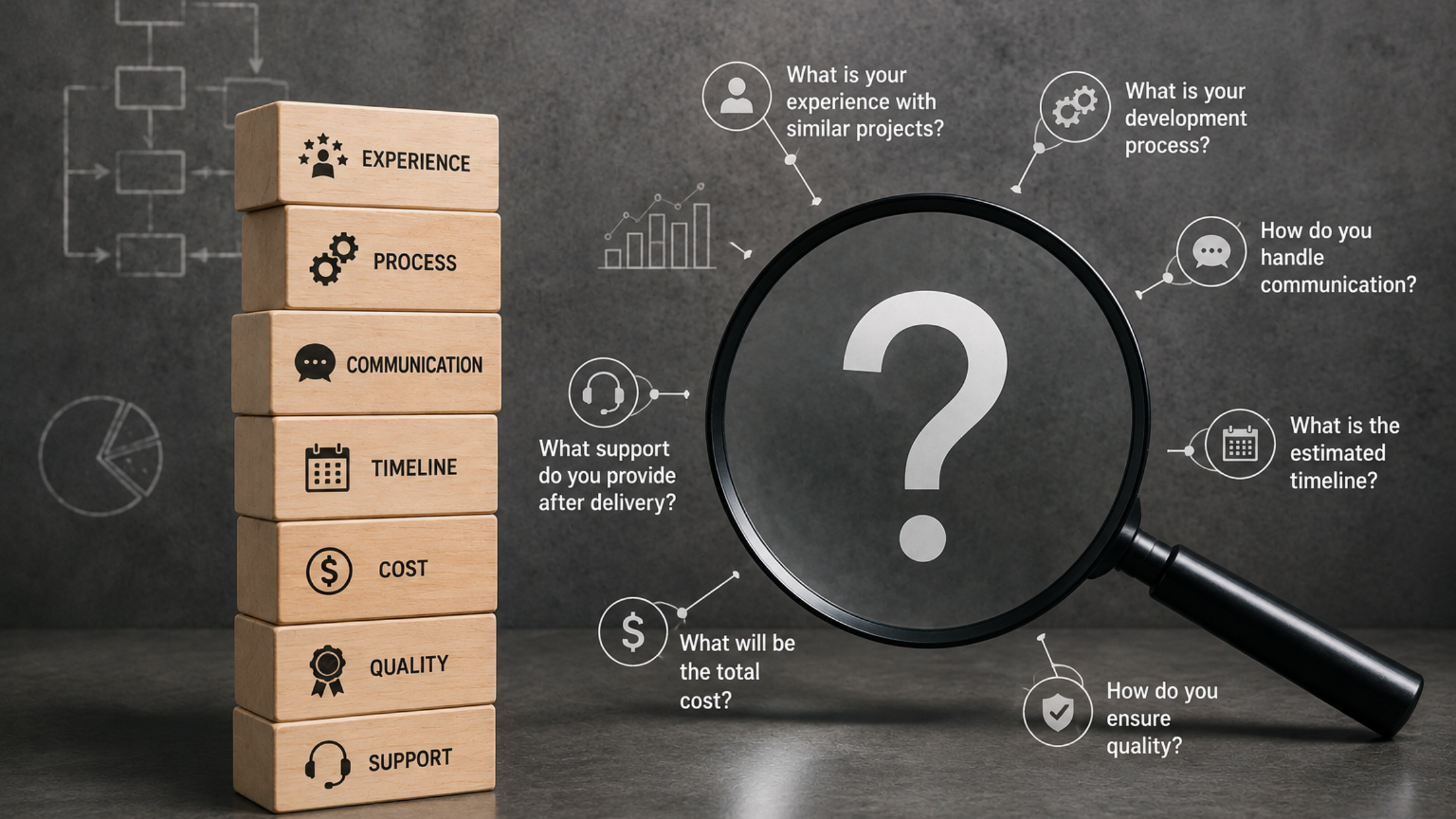
Before signing an agreement or starting development, businesses should have a detailed conversation with the software company about the project, the people involved, the development process, ownership, security, maintenance, and what happens after launch. Here are the most important questions to ask before starting a software project.
1. Have You Worked on Similar Software Projects Before?
One of the first questions to ask is whether the software company has experience with projects similar to yours. You do not necessarily need a company that has built exactly the same application. However, experience with similar business requirements, industries, technologies, integrations, or project complexity can be valuable.
Ask the company to explain the type of projects it has worked on and what role it played in those projects. If possible, ask for examples that demonstrate its experience rather than relying only on general statements about expertise. A company that understands similar challenges may be able to identify potential problems earlier and suggest approaches that have already worked in comparable situations.
It is also useful to understand whether the company has experience building software that needs to integrate with existing systems, because many business projects involve more than developing a standalone application.
2. How Will You Understand Our Business Requirements?
A software project should begin with understanding the business problem, not simply listing technical features. Ask the software company how it plans to understand your current processes, users, challenges, and goals before development begins. A strong discovery process may involve discussions with stakeholders, reviewing existing systems, understanding user roles, mapping current workflows, identifying pain points, and defining the desired outcome.
This step matters because a technically functional application can still fail if it solves the wrong problem. For example, a business may initially ask for a new customer management system because its existing process is difficult to manage. During discovery, the software company may discover that the bigger issue is fragmented data and unclear internal processes. Understanding the underlying problem can lead to a much better solution.
3. What Will Be Included in the Project Scope?
The project scope should clearly explain what the software company is expected to deliver. Ask for a detailed explanation of the features, modules, integrations, user roles, platforms, and other deliverables included in the project. The scope should be understandable to both technical and non-technical stakeholders.
It is also important to discuss what is not included. This prevents assumptions later. For example, if a project includes customer management, clarify whether that includes contact management, activity tracking, reporting, notifications, import tools, integrations, and user permissions, or whether some of those items are separate requirements. A clearly defined scope gives both sides a common understanding of what is being built.
4. What Technology Will You Use and Why?
You do not need to be a software developer to ask about the technology behind your project. Ask which technologies, frameworks, databases, hosting environments, and other technical components will be used and, more importantly, why they are appropriate for your requirements. The answer should relate to the needs of the project rather than simply listing popular technologies.
For example, the technology choices may depend on the expected number of users, performance requirements, integrations, security needs, mobile requirements, future expansion, and maintenance considerations. Understanding the technology stack can also help you assess whether the solution will be maintainable and scalable over time.
5. How Long Will the Project Take?
Ask for an estimated timeline and request that it be broken into meaningful stages rather than receiving only one final delivery date. A software project may include stages such as requirements discovery, design, development, integration, testing, user acceptance testing, deployment, and post-launch support. Breaking the project into stages makes progress easier to understand.
It also helps identify where delays could occur. However, a realistic software company should be careful about promising an exact completion date before fully understanding the project requirements. The timeline should be based on the agreed scope, dependencies, resources, and complexity. Ask what assumptions the timeline depends on and what could cause the schedule to change.
6. Who Will Work on the Project?
You should know who is responsible for delivering your software. Ask whether the project will be handled by an internal team, freelancers, external contractors, or a combination of resources. It is also useful to understand the roles involved, such as project managers, business analysts, designers, developers, quality assurance specialists, and technical leads.
Knowing who is responsible for different parts of the project makes communication easier and provides accountability. You should also know who your primary point of contact will be throughout development.
7. How Will We Communicate During Development?
Communication can have a major impact on the success of a software project. Ask how often you will receive updates, where project discussions will take place, how decisions will be documented, and who should be contacted when an issue arises. You may also want to understand how progress will be demonstrated.
Regular demonstrations can be particularly useful because they allow stakeholders to see the software as it develops instead of waiting until the end of the project to discover that something needs to change. A clear communication process helps prevent small misunderstandings from becoming major project problems.
8. How Will Changes to the Project Be Handled?
Changes are common in software development. As users see working versions of the application, they may discover new requirements or realize that an existing feature needs to work differently. Ask the software company how changes will be evaluated and priced.
You should understand the difference between correcting something that was part of the original requirement and introducing a genuinely new requirement. A good change management process should explain how a change affects scope, cost, resources, and timeline before the work begins. This prevents unexpected costs and disagreements later.
9. How Will You Test the Software?
Testing should be part of the development process rather than something that happens only at the end. Ask what types of testing will be performed and who will be responsible for it. Depending on the project, testing may include functional testing, integration testing, performance testing, security testing, usability testing, compatibility testing, and user acceptance testing.
You should also ask how software defects will be reported, prioritized, fixed, and retested. The goal is not simply to confirm that the application opens and basic functions work. Testing should determine whether the software performs reliably under the conditions in which your business will actually use it.
10. How Will Security Be Handled?
Security should be discussed before development begins, particularly when the software will handle customer information, financial information, employee data, business records, or other sensitive information. Ask how the application will protect data during storage and transmission.
You should also discuss authentication, authorization, user permissions, password management, backups, logging, and access controls where relevant. If your business operates in a regulated environment or handles data subject to specific legal requirements, ask how those requirements will be addressed. The exact security requirements will depend on the nature of the application, the type of data involved, and the countries or industries in which the software will operate.
11. Who Will Own the Software and Source Code?
This is one of the most important questions to ask before development begins. Clarify who will own the final software, source code, designs, documentation, databases, and other project assets after payment and completion. The contract should clearly define intellectual property rights.
Do not assume that paying for development automatically answers every ownership question. If the software company uses its own pre-existing libraries, frameworks, components, or third-party services, ask how those elements are licensed and what rights your business receives. Clear ownership terms can prevent significant problems if you later want to change development partners or modify the application.
12. Will We Be Able to Access Our Data?
Your business data should not become inaccessible because you change software providers. Ask where your data will be stored, how it can be accessed, and how it can be exported if necessary. You should also understand the database structure at a high level and whether there are restrictions on exporting information.
If the application is hosted by the software company or a third-party provider, ask what happens to your data if the contract ends. Having clear data access and exit arrangements is an important part of protecting your business.
13. How Will the Software Integrate With Our Existing Systems?
Most modern businesses already use multiple software platforms. Your new application may need to connect with accounting software, CRM platforms, payment systems, databases, communication tools, e-commerce platforms, or internal systems. Ask which integrations are included in the project and how they will work.
You should also discuss whether the integration depends on APIs, third-party services, or custom development. It is important to identify integration requirements early because they can significantly affect project complexity, timeline, and cost.
14. Will the Software Be Scalable?
A software system should not only work for your business today. It should be able to support reasonable future growth. Ask what happens if your number of users, customers, transactions, or data increases significantly.
Scalability can involve infrastructure, database architecture, application design, performance, storage, and technical architecture. The right approach depends on the project, but the software company should be able to explain how the solution has been designed to accommodate expected growth.
15. What Happens After the Software Goes Live?
Launching the software is not necessarily the end of the project. Ask what support is available after deployment. You should understand whether the agreement includes a warranty period, bug fixes, technical support, maintenance, updates, monitoring, backups, or other post-launch services.
It is also useful to clarify how support requests are submitted and how urgent issues are handled. A software system becomes part of your business operations after launch, so having a clear support arrangement is important.
16. Will You Provide Documentation and Training?
Even well-designed software can create problems if employees do not know how to use it. Ask whether the software company will provide documentation, training sessions, user guides, administrator instructions, or other resources.
Training requirements will depend on the size and complexity of the application. If the system will be used by different departments, you may need different training approaches for administrators, managers, and regular users. The goal is to make sure the software is not only delivered but actually adopted by the people who need to use it.
17. How Much Will the Project Cost?
Price is obviously an important consideration, but it should not be the only question. Ask the software company to explain what the quoted price includes and whether there are additional costs associated with hosting, third-party services, licenses, integrations, maintenance, support, or future changes.
You should also ask how payments are structured throughout the project. A lower initial quote is not always the least expensive option in the long term if it excludes important requirements or creates significant additional costs later. The better approach is to compare the overall scope, quality, support, ownership, and long-term value of each proposal.
18. What Could Go Wrong With This Project?
This may be one of the most valuable questions you can ask. Instead of only asking a software company to explain why the project will succeed, ask what risks it sees. Potential risks may include unclear requirements, difficult integrations, data migration, third-party dependencies, security requirements, user adoption, changing requirements, or technical limitations.
A company that openly discusses risks is often more useful than one that promises that everything will be easy. The purpose is not to eliminate every risk. That is rarely possible. The goal is to identify important risks early and create a plan for managing them.
What a Good Software Company Should Do Before Development Begins
A professional software company should not rush directly into development without understanding the project. Before writing significant amounts of code, the team should work with you to understand the business requirements, users, workflows, technical requirements, integrations, security considerations, project scope, and expected outcomes.
The company should also be willing to explain technical decisions clearly and identify areas that require further clarification. Good software development is not simply about writing code quickly. It is about building the right solution for the right problem and creating a process that allows both the business and development team to work from the same expectations.
Final Checklist Before Starting Your Software Project
Before signing off on a software project, make sure you have clear answers to the major questions surrounding the project. You should understand:
- What problem the software is solving
- What features are included
- What is outside the project scope
- Which technology will be used
- Who will work on the project
- How long development is expected to take
- How communication will work
- How changes will be handled
- How testing will be performed
- How security will be addressed
- Who owns the software and source code
- How your data will be accessed and exported
- Which integrations are included
- How the system will support future growth
- What support is available after launch
- What training and documentation will be provided
- What the total project cost includes
- What risks could affect the project
Having these answers in writing gives your business a much stronger foundation before development starts.
Wrapping It Up
Choosing a software company is about more than comparing prices or looking at a list of technologies. The right technology partner should understand your business requirements, ask the right questions, communicate clearly, define the project properly, and help you make informed decisions throughout development. Taking the time to discuss scope, technology, integrations, security, ownership, testing, timelines, and long-term support can prevent many of the problems that businesses face after development has already started.
At Hakimi Solutions, we believe a successful software project starts with understanding the business behind the technology. Every business has different processes, users, challenges, and goals, which is why software should be planned around those requirements rather than forcing the business to work around a generic solution. From understanding your requirements and planning the right approach to developing, implementing, and supporting the solution, the focus should remain on creating software that is practical, reliable, and aligned with the way your business operates.
Whether you are planning a new software project, upgrading an existing system, or looking for a technology solution built around your specific business requirements, asking the right questions is the first step toward making a better decision. The better the conversation before development begins, the stronger the foundation for the software you ultimately build with Hakimi Solutions.