
B2B vs B2C Website Design
A website may look like a collection of pages, images, buttons, and information, but its real purpose is much more specific: it needs to help the right customer make the right decision. That decision can look completely different depending on whether a business sells to other businesses or directly to individual consumers. This is why applying the same website design approach to both B2B and B2C companies often leads to websites that look professional but fail to support the way their customers actually buy.
Consider the difference between someone purchasing a pair of shoes online and a company looking for a new industrial equipment supplier. The person buying shoes may discover the product through an advertisement, compare a few styles, check reviews, select a size, and complete the purchase within minutes. The company purchasing industrial equipment may spend weeks researching suppliers, comparing technical specifications, requesting quotations, checking certifications, involving several decision-makers, and negotiating commercial terms before placing an order.
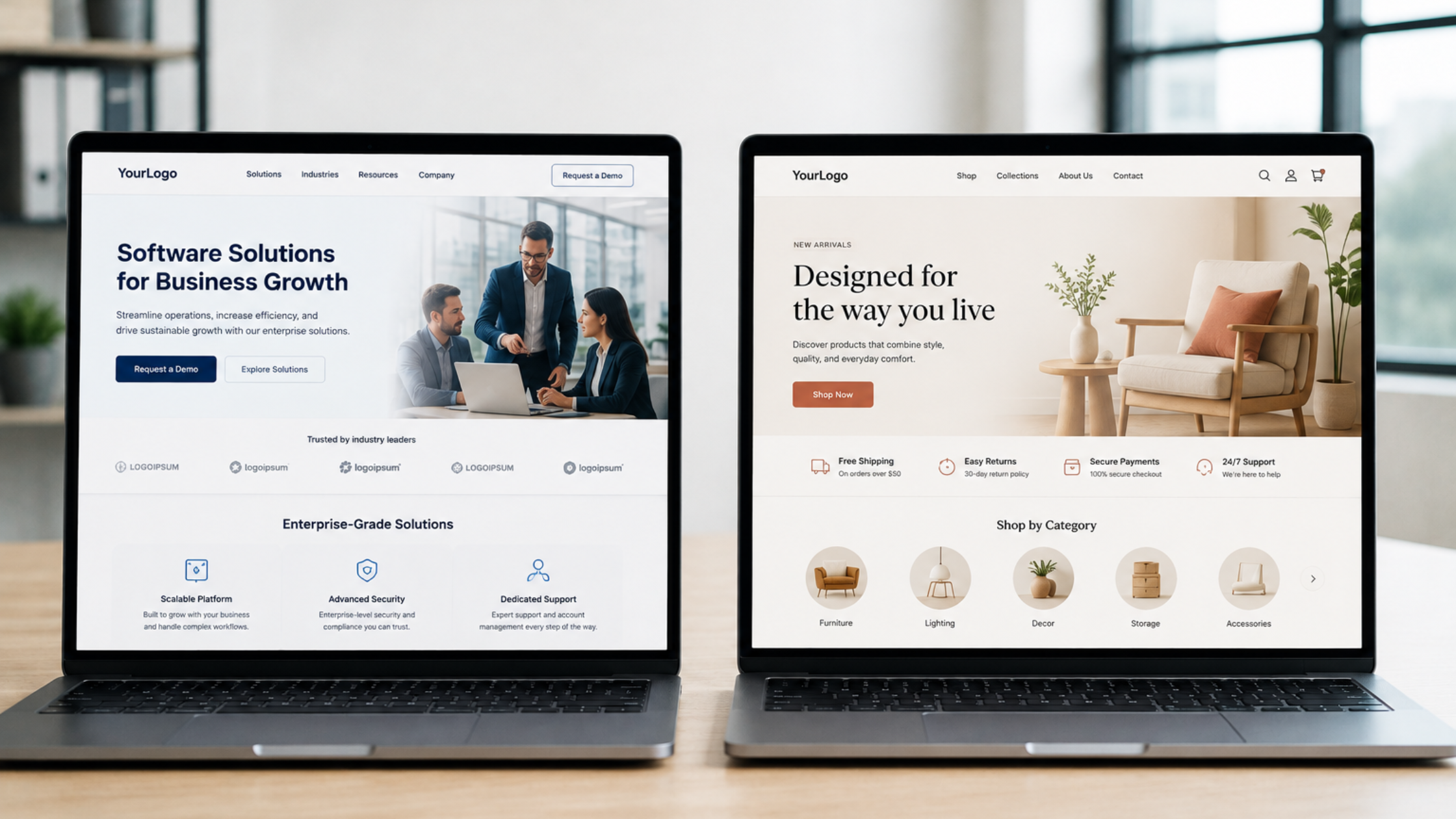
Both customers use websites during their buying journey, but they need very different experiences. A B2C website often needs to create interest quickly, make products easy to discover, reduce hesitation, and provide a convenient path to purchase. A B2B website generally needs to communicate expertise, provide detailed information, establish credibility, answer complex questions, and give potential buyers enough confidence to begin a business conversation.
The distinction affects almost everything about the website, from homepage messaging and navigation to content, calls to action, product pages, trust signals, forms, and functionality. Understanding these differences is essential before deciding how your business website should be structured. In this article, we’ll look closely at B2B vs B2C website design, the major differences between the two approaches, and how businesses can create websites that match the way their customers actually make decisions.
What Is a B2B Website?
A B2B, or business-to-business, website represents a company whose primary customers are other businesses. Examples include manufacturers, wholesalers, software companies, professional service providers, industrial suppliers, logistics companies, distributors, and agencies.
The purpose of a B2B website isn’t always to generate an immediate online transaction. In many industries, the website’s job is to generate a qualified enquiry and give potential customers enough information to consider the company as a serious supplier or partner.
Imagine a manufacturer looking for a packaging supplier. The purchasing team may visit several websites while researching potential vendors. They aren’t necessarily looking for a “Buy Now” button. They may want to understand the supplier’s manufacturing capabilities, materials, production capacity, quality standards, certifications, industries served, customization options, delivery capabilities, and previous experience.
The website therefore becomes an important part of the company’s sales process. Before speaking to a salesperson, potential customers may already have formed an opinion about whether the company appears capable of handling their requirements.
For this reason, B2B website design needs to balance clarity with depth. Visitors should quickly understand what the company provides, but they should also be able to explore detailed information when evaluating whether the business is suitable for a long-term commercial relationship.
What Is a B2C Website?
A B2C, or business-to-consumer, website serves individual customers rather than organizations. Fashion retailers, restaurants, travel companies, beauty brands, electronics stores, fitness businesses, entertainment platforms, and many eCommerce companies operate primarily in the B2C market.
In B2C, the purchasing decision is often made by one person or household and can happen much faster. A customer browsing an online clothing store might discover a product, check available colours and sizes, read reviews, compare prices, and purchase within the same session.
Because of this, B2C website design generally places greater emphasis on product discovery, visual appeal, convenience, promotions, social proof, and reducing friction during the buying process.
This doesn’t mean B2C websites require less information. Customers still want clear product descriptions, shipping information, return policies, reviews, payment security, and customer support. The difference is how that information is presented. Instead of requiring visitors to research extensively before taking action, a B2C website usually aims to make the path from interest to purchase as smooth as possible.
Understanding this fundamental difference in buying behaviour is the starting point for designing both types of websites effectively.
1. B2B and B2C Customers Have Different Buying Journeys
The biggest difference between B2B and B2C website design begins before visual design enters the conversation. The customer journey itself is different. A B2C purchase can sometimes happen within minutes. A customer sees an Instagram advertisement for a skincare product, visits the website, checks reviews, adds the product to the cart, and completes the purchase. The website needs to maintain momentum throughout this relatively short journey.
B2B buying journeys are often longer and involve considerably more research. A company searching for new accounting software, for example, may compare several providers, attend product demonstrations, discuss requirements internally, calculate implementation costs, and seek approval from management before making a decision.
There may also be several people involved. The employee who initially discovers the product may not be the person approving the purchase. Finance may evaluate cost, IT may assess compatibility, management may consider business impact, and end users may want to understand how the solution affects their daily work.
A B2B website therefore needs to support different questions at different stages of the decision. High-level service pages may help someone initially understand the offering, while case studies, technical documentation, FAQs, integrations, industry pages, and detailed product information can help the organization evaluate the solution more seriously. Website design becomes more effective when it reflects the actual buying journey instead of forcing every visitor toward the same action.
2. Homepage Messaging Needs to Work Differently
Every website homepage should answer a basic question quickly: “What does this company do, and is it relevant to me?” How that message is delivered, however, often differs significantly between B2B and B2C businesses.
A B2C homepage may lead with products, collections, seasonal campaigns, new arrivals, discounts, or lifestyle imagery. Someone visiting a fashion brand doesn’t need a lengthy explanation of the company’s business model before browsing. They want to see products that interest them and understand why they should buy from this particular brand.
A B2B visitor often needs more context. If a company provides industrial automation services, for example, a generic headline such as “Building a Better Tomorrow” tells a potential buyer almost nothing. The homepage should make the company’s capabilities, target industries, and value proposition clear enough for visitors to immediately determine whether they’ve found the right provider.
Good B2B messaging tends to prioritize clarity and relevance over cleverness. Visitors should understand what problem the company solves, who it solves it for, and what makes its approach credible. Once this foundation is established, supporting sections can introduce capabilities, industries, case studies, certifications, or other information that strengthens the buying decision. In both cases, attractive design matters, but clarity should never be sacrificed simply to make a homepage look impressive.
3. Calls to Action Reflect Different Customer Intent
Calls to action are another area where copying the same approach between B2B and B2C websites creates problems. Common B2C calls to action include “Shop Now,” “Add to Cart,” “Buy Now,” “Book Now,” or “Get 20% Off.” These actions work because customers are often able to complete the next step independently.
B2B decisions frequently require a conversation before a purchase can happen. The website may therefore use calls to action such as “Request a Quote,” “Book a Demo,” “Talk to Our Team,” “Download Specifications,” or “Discuss Your Requirements.”
The difference isn’t simply wording. It reflects where the customer is in the buying process. For example, putting a “Buy Now” button on a custom manufacturing service wouldn’t make sense if pricing depends on material, volume, specifications, and delivery requirements. Similarly, forcing someone to “Contact Sales” to purchase a simple consumer product creates unnecessary friction. Effective website design aligns calls to action with what customers realistically want to do next.
4. B2B Websites Usually Need More Detailed Content
B2B purchases often involve greater financial commitment, longer relationships, and more operational risk. As a result, buyers typically require more information before they feel comfortable contacting a supplier. A company considering a new logistics partner may want to know which regions are covered, what industries the provider serves, what tracking capabilities are available, how international shipments are handled, and whether the provider can support the required volume. A few attractive images and a short service description won’t answer those questions.
This is why strong B2B websites frequently include detailed service pages, industry-specific pages, case studies, technical documentation, FAQs, certifications, downloadable resources, and insights that demonstrate expertise. The key is organizing that information properly. More content shouldn’t mean overwhelming visitors with huge blocks of text. Good information architecture allows visitors to begin with a simple overview and move deeper when they need additional detail.
B2C content tends to be more focused around products and purchase confidence. Product specifications still matter, but photography, reviews, benefits, sizing information, delivery details, comparisons, and frequently asked questions often play a larger role in helping customers make quick decisions. Both approaches require useful content; the difference lies in the questions that content needs to answer.
5. Trust Is Built Differently in B2B and B2C
Trust influences almost every online purchase, but businesses and consumers often look for different evidence before they feel confident. B2C customers may look for product reviews, star ratings, secure payment options, easy returns, customer photographs, social media presence, clear shipping policies, and recognizable payment methods. These signals reduce the perceived risk of purchasing from a company the customer may never have interacted with before.
B2B buyers often look for evidence of capability. Case studies, recognizable clients, years of experience, certifications, partnerships, manufacturing facilities, compliance standards, project outcomes, testimonials, and detailed company information can all help establish credibility.
For an industrial supplier, displaying relevant quality certifications may influence a purchasing decision far more than a promotional banner. For an online fashion store, hundreds of verified customer reviews may be considerably more persuasive than a detailed corporate history. The important lesson is that trust signals shouldn’t be added simply because other websites use them. They should address the specific concerns customers have before choosing your business.
6. Navigation and Website Structure Serve Different Goals
B2C navigation is often designed around discovery. An eCommerce fashion website might organize products by men, women, category, collection, occasion, price, or new arrivals. Filters and search tools allow customers to narrow down hundreds or thousands of products quickly.
B2B navigation usually needs to help visitors understand capabilities. A manufacturing company might organize its website around products, industries, applications, technical resources, certifications, and company information. A software provider might use sections for solutions, features, integrations, industries, pricing, and resources.
The structure should reflect the questions visitors are likely to ask. A purchasing manager may arrive looking specifically for a technical product category, while another visitor may want to know whether the company serves their industry. Both should be able to reach relevant information without navigating through unrelated pages. Poor navigation creates friction regardless of the business model. The difference is what visitors are trying to discover and how the website helps them get there.
7. Product and Service Pages Have Different Responsibilities
A B2C product page often has one primary objective: give the customer enough confidence to add the item to their cart. That means presenting high-quality images, product benefits, variations, pricing, availability, reviews, delivery information, return policies, and a clear purchase button. Every element should reduce uncertainty and make purchasing straightforward.
A B2B product or service page may have a very different role. An industrial chemical supplier, for example, may need to show product categories, applications, technical properties, available grades, packaging options, safety information, certificates, and enquiry options. The visitor may not purchase anything directly from the page, but the information helps determine whether the supplier should be contacted.
Service businesses face a similar challenge. A B2B consulting firm needs to explain not only what it provides but also how the engagement works, which problems it addresses, what experience it brings, and what outcomes clients can reasonably expect. Designing these pages around actual buying questions makes them far more valuable than treating them as simple descriptions of what the company sells.
8. Conversion Means Something Different for Each Website
When people hear “website conversion,” they often think about an online purchase. For many B2B websites, however, that isn’t the primary conversion at all. A successful B2B conversion could be a quotation request, consultation booking, product enquiry, brochure download, demo request, or qualified contact form submission. The website’s responsibility is often to move the visitor into the sales process rather than complete the entire transaction online.
B2C conversions are more commonly transactional. Product purchases, subscriptions, reservations, account registrations, and promotional sign-ups can often happen directly through the website. This difference matters when evaluating whether a website is performing successfully. Measuring a B2B manufacturing website purely by online sales would make little sense if the company’s contracts are finalized offline. Likewise, measuring an eCommerce website only by contact form submissions would ignore its primary commercial purpose.
Website goals should therefore be established before design begins. Once the desired conversion is clear, page layouts, calls to action, forms, content, and functionality can all support that outcome.
9. Functionality Should Match the Sales Process
The technology behind a website should reflect how the business actually operates rather than being added simply because a feature looks impressive. B2C eCommerce websites may require product search, filters, wishlists, carts, payment gateways, discount codes, customer accounts, order tracking, recommendations, and inventory synchronization. These features support a largely self-service buying experience.
B2B websites may require quotation systems, CRM integrations, gated resources, appointment scheduling, custom product configurators, dealer portals, bulk ordering, account-specific pricing, document downloads, or integration with internal business systems.
Some businesses operate across both models. A manufacturer might sell standard products directly online while handling large commercial orders through quotation requests. A software company may allow small businesses to subscribe immediately while directing enterprise customers toward a sales consultation.
In these cases, website design needs to accommodate multiple buying journeys without making the experience confusing. The right functionality should remove friction from the sales process rather than introducing technology for its own sake.
10. Mobile Experience Matters for Both, but the Context Can Differ
Mobile-friendly design is no longer optional for either B2B or B2C websites. Customers frequently discover businesses, research products, read reviews, and make enquiries from their phones. However, the way mobile devices are used can differ depending on the purchase.
A B2C customer may complete the entire journey on mobile, from discovering a product through social media to completing payment. This makes fast-loading product pages, simple navigation, mobile-friendly checkout, and convenient payment options extremely important.
A B2B buyer may initially discover a supplier on mobile but later return from a desktop to review technical documents, compare solutions, or complete a detailed enquiry. That doesn’t make the mobile experience less important. The first visit may determine whether the buyer considers the company worth researching further.
Responsive design therefore needs to consider more than whether pages technically fit on smaller screens. Content hierarchy, button placement, forms, navigation, tables, product information, and downloadable resources should all remain usable regardless of device.
Should Your Website Follow a B2B or B2C Design Approach?
The answer depends less on what your company calls itself and more on how your customers make purchasing decisions. If customers generally make individual, relatively quick purchasing decisions and can complete transactions without speaking to your team, your website will probably benefit from many B2C design principles. Product discovery, visual presentation, reviews, convenience, and a frictionless checkout experience should receive significant attention.
If your sales process involves research, multiple decision-makers, customized requirements, quotations, demonstrations, or consultation, a B2B approach will usually make more sense. Detailed information, credibility, lead generation, clear service explanations, and strong enquiry pathways become more important. Some companies need elements of both. The important thing is not to force the business into a design category but to understand the customer’s journey and build around it.
Before redesigning or developing a website, businesses should therefore ask several practical questions: Who makes the buying decision? What information do they need before taking the next step? How long does the decision normally take? Does the transaction happen online or through the sales team? What concerns could prevent someone from choosing us? What should visitors realistically do after viewing an important page? The answers provide a much stronger foundation for website design than simply choosing a template because it looks attractive.
Wrapping It Up
B2B and B2C websites share many fundamentals. Both should be fast, responsive, easy to navigate, visually credible, and built around the needs of their users. The real difference appears when you look deeper at how those users research, evaluate, and purchase.
B2C website design generally needs to help individual customers discover products, build confidence quickly, and move smoothly towards a transaction. B2B website design often needs to support a longer decision-making process by providing deeper information, establishing expertise, demonstrating credibility, and making it easy for qualified prospects to begin a conversation.
Neither approach is inherently better. What matters is whether the website reflects the way your customers actually buy. A beautiful B2B website can still underperform if potential clients cannot find technical information or understand the company’s capabilities. An attractive B2C store can lose sales if customers struggle to find products or complete checkout. Good website design isn’t simply about appearance; it connects business objectives with customer behaviour.
At Hakimi Solutions, we approach website development with that distinction in mind. Whether we’re building a B2B corporate website, an eCommerce store, a service-based platform, or a website that combines multiple sales journeys, the focus is on creating an experience that makes sense for the people using it. From website strategy and user experience to development, eCommerce functionality, integrations, and ongoing support, the goal is to build a digital presence that supports how the business actually sells.
Before asking what your next website should look like, it may therefore be worth asking a more important question: how do your customers decide to buy from you? Once that is clear, the right website experience becomes much easier to build.