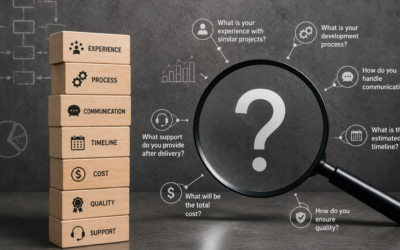


Choosing the Right Technology: The Value of Business Consulting
Technology has become part of almost every business decision. Companies use digital systems to manage customers, communicate with teams, sell products, deliver services, process information, track performance, and support day-to-day operations. As businesses grow, the number of technology decisions they need to make grows with them. The difficult part is rarely finding technology. There are thousands of platforms, applications, development frameworks, tools, and digital solutions available. The real challenge is understanding which of those options actually makes sense for a particular business.
Should the company use an existing platform or develop something custom? Does it need a mobile application, or would another digital solution serve customers better? Should an existing system be replaced, upgraded, or integrated with something new? Which features are genuinely necessary, and which ones will add cost without solving an important problem? These decisions can have long-term consequences. Choosing technology that does not fit the business can lead to unnecessary expenses, complicated workflows, poor adoption, repeated migrations, and systems that become difficult to maintain as the company grows.
This is where business consulting becomes valuable. Instead of beginning with a particular technology, effective consulting begins with the business itself: its objectives, current processes, challenges, users, budget, existing systems, and plans for growth. The goal is not simply to introduce more technology. It is to make better technology decisions.
Technology Should Start With a Business Need
One of the most common mistakes businesses make is beginning with a tool instead of beginning with a problem. A company hears about a popular platform and decides it needs it. A competitor launches a mobile application, so the company assumes it should build one too. A new AI tool becomes popular, and management starts looking for ways to implement AI before deciding what problem it needs to solve. This approach reverses the decision-making process.
Technology should normally be selected after the business requirement is understood. Suppose a company says, “We need a mobile app.” A consultant would first need to understand why. Are customers repeatedly returning to use a service? Does the business need mobile-specific functionality? Would notifications improve engagement? Is there a process customers need to complete frequently? After examining the requirement, a mobile application may indeed be the right solution. In another case, improving an existing digital platform or introducing a simpler solution may achieve the same objective with less complexity.
Business consulting helps businesses ask these questions before committing significant time and money to implementation. The first question should therefore not be, “Which technology should we buy?” It should be, “What are we trying to improve?”
Understand the Current Business Before Planning the Future
Choosing technology without understanding existing processes can create new problems instead of solving old ones. In business consulting, understanding how the business currently operates is essential before recommending a solution. How does information move between departments? Which processes depend on manual work? What systems are already being used? Where do employees experience delays? What complaints do customers frequently raise? Which tasks are duplicated? Where does important information become difficult to access? The answers create a picture of the current environment.
For example, a business may believe it needs completely new software because employees struggle to access information. After reviewing the process, the actual issue might be that existing systems are poorly connected or that information is being entered inconsistently. In another situation, the existing system may genuinely have reached its limits and replacing it may be more practical than repeatedly working around its limitations. There is no universal answer. Business consulting helps separate symptoms from underlying problems so that technology decisions address the actual cause rather than simply adding another system.
Define What the Technology Needs to Accomplish
Once the problem is clear, the next step is translating business needs into practical requirements. This is where vague objectives become specific. A statement such as “We need a better customer experience” is too broad to guide a technology decision. What exactly needs to improve?
Perhaps customers need to complete bookings without contacting the team. Maybe they need access to their account information from a mobile device. The business might want customers to track orders, submit documents, make payments, or receive important updates digitally. Each requirement can lead to a different technology approach. The same principle applies internally.
A business wanting to “improve operations” needs to identify whether that means reducing repetitive data entry, improving access to information, simplifying approvals, creating better reporting, or connecting existing systems. In business consulting, clear requirements make it easier to evaluate technology based on relevance rather than marketing claims. A solution with hundreds of features is not necessarily better than one with twenty if the smaller solution addresses the requirements more effectively.
Avoid Choosing Technology Based Only on Popularity
Popular technology can be excellent technology, but popularity alone is not a business case. Different organizations have different processes, budgets, team sizes, technical environments, customer expectations, and growth plans.
A platform that works extremely well for a large enterprise may be unnecessarily complicated for a growing company. A simple tool that works perfectly for a small business may become restrictive once operations expand. The same applies to development technologies. Choosing a framework, platform, architecture, or development approach because it is currently popular does not automatically make it suitable for the project.
The decision should consider the intended functionality, expected scale, security requirements, integrations, maintenance needs, available expertise, budget, and long-term plans. Business consulting provides an additional layer between discovering a solution and committing to it. Instead of asking only “What can this technology do?”, the business can ask “Does what it does match what we actually need?” That small change in perspective can prevent expensive decisions later.
Decide Whether to Build, Buy, Customize, or Integrate
Many technology decisions eventually lead to one of four broad options: use an existing solution, customize an available platform, build something specifically for the business, or connect existing systems through integrations. Each approach has advantages and limitations. An existing product may provide faster implementation and lower initial development effort. However, the business may need to adapt some of its processes to fit the software.
Customization can provide more flexibility while still benefiting from an established platform, but excessive customization can sometimes increase maintenance complexity. Custom development gives the business greater control over functionality and experience, but it requires more planning, development, testing, and ongoing maintenance. Integration can be the right approach when the business already has systems that work well individually but needs them to exchange information or operate as part of a connected process. The correct choice depends on the situation.
Business consulting can help evaluate these options based on the business requirement rather than assuming custom development is always better or that an off-the-shelf product is always cheaper. Sometimes the best technology decision is not replacing anything at all.
Consider How New Technology Fits With Existing Systems
Very few established businesses operate with only one digital system. They may already have accounting software, customer databases, internal applications, websites, eCommerce platforms, payment systems, communication tools, cloud services, and other technologies. Introducing another solution without considering this environment can create additional fragmentation.
As part of business consulting, businesses should consider how new technology will interact with what already exists before adopting it. Will customer information need to move between systems? Does the new solution support the required integrations? Will employees need to enter the same information more than once? Can existing data be migrated? Are APIs or other integration methods available? These questions are important because the value of a technology is not determined only by what it can do independently. It also depends on how well it fits into the wider technology environment of the organization.
Business consulting can help evaluate these dependencies before implementation begins, reducing the risk of discovering major integration limitations after the business has already invested in the solution.
Think Beyond Today’s Requirements
A technology solution may fit perfectly today and become restrictive surprisingly quickly if future growth was never considered. This does not mean every business should build an enterprise-level system from the beginning. Overengineering can be just as expensive as choosing something too limited. An important part of business consulting is understanding what is likely to change as the business grows. Will the number of users increase? Is the company planning to expand into additional markets? Will new services or products be introduced? Could transaction volume grow significantly? Are more integrations likely to be required later?
Scalability is not simply about whether a server can handle more traffic. It can also involve licensing structures, user limits, data capacity, workflow flexibility, integrations, administrative complexity, and the ability to introduce new functionality. Consulting helps businesses balance current needs with realistic future requirements. The right solution should work for the business now while leaving reasonable room for growth.
Look at the Total Cost, Not Just the Initial Price
Technology decisions are often compared based on upfront cost. However, the cheapest option at the beginning is not necessarily the least expensive over time. Business consulting should consider the total cost of adopting and operating the technology, not simply the initial price. That can include licensing, development, customization, integration, migration, hosting, maintenance, upgrades, training, technical support, and future expansion. There can also be indirect costs.
If employees need significantly more time to complete tasks because a system is difficult to use, that has a cost. If information needs to be entered manually into multiple systems because integration is unavailable, that creates ongoing operational effort. Conversely, an expensive solution is not automatically better simply because it contains more features. A useful technology investment is one where the cost makes sense in relation to the problem being solved and the value the solution is expected to create. Business consulting helps bring these considerations into the decision before a budget is committed.
User Experience Should Be Part of the Technology Decision
A technology can be technically capable and still fail if people struggle to use it. This is particularly important for customer-facing digital products. A mobile application might contain every requested feature, but if customers cannot navigate it comfortably, the technical capabilities will not create the intended experience. The same applies to internal systems. If employees find a new platform confusing or unnecessarily complicated, adoption may be slow and teams may continue using their previous methods.
Business consulting should therefore consider the people who will actually interact with the technology solution. What level of technical knowledge do they have? How frequently will they use it? Which tasks need to be completed quickly? Will employees require training? Does the interface make important information easy to find? UI and UX are therefore not isolated design considerations. They can influence whether a technology solution is practically successful. The best system on paper is of limited value if the intended users avoid using it.
Implementation Matters as Much as Selection
Choosing the correct technology is only part of the process. Implementation determines whether that technology becomes useful in practice. A business can select a highly capable solution and still experience poor results if requirements were not configured correctly, data was migrated incorrectly, integrations were incomplete, testing was rushed, or employees were not prepared for the change. This is why business consulting should not necessarily end when a product or approach has been selected.
The implementation plan needs to consider priorities, responsibilities, timelines, dependencies, testing, data, integrations, user training, and launch strategy. For larger projects, phased implementation may be more practical than attempting to change everything at once. A phased approach allows businesses to introduce the most important functionality first, observe how it performs in real situations, and then expand based on actual experience. Technology creates value when it becomes part of a working business process, not simply when it has been purchased or developed.
Know When Not to Introduce New Technology
One of the most valuable outcomes of consulting can sometimes be deciding not to add another tool. Businesses often accumulate technology over time. A new problem appears, so another application is added. A department needs a feature, so it subscribes to another platform. Eventually, the company may have multiple systems with overlapping functionality.
Business consulting can also help determine whether the existing technology can already solve the problem before something new is introduced. Perhaps a feature has not been configured. Maybe an existing platform can be extended. An integration might remove the need for another application. In some cases, the real issue may be the business process rather than the software. Good consulting should not begin with the assumption that the answer is always more technology. Sometimes simplifying the technology environment creates more value than expanding it.
The Value of an Outside Perspective
Internal teams understand their business extremely well, but that familiarity can occasionally make it difficult to question established processes. A task may have been performed the same way for years simply because “that is how we have always done it.”
An outside consultant can examine the process without those assumptions. Why does this information need to be entered twice? Why does this approval require four steps? Why is this report being created manually? Why do customers need to contact an employee to complete something that could potentially be self-service? The purpose is not to criticize existing processes. Many of them were created for good reasons at the time. The objective is to determine whether those reasons still apply and whether technology can support a better approach today. Business consulting therefore creates value not only through technical knowledge but also through structured questioning.
How Hakimi Solutions Approaches Business Consulting
At Hakimi Solutions, business consulting begins with understanding the requirement rather than immediately recommending a particular technology. Every business operates differently. Its customers, processes, existing systems, team structure, budget, and growth plans influence what kind of digital solution makes sense.
The business consulting process can involve understanding the current environment, identifying business challenges, defining requirements, evaluating technology options, and determining whether the appropriate approach involves an existing solution, integration, customization, mobile application, digital platform, or custom development. Because Hakimi Solutions works across areas including digital strategy, UI/UX, mobile applications, development, integrations, and other technology solutions, the conversation can begin with the business objective rather than being limited to one particular type of implementation. The objective is not to introduce technology simply because it is available. It is to identify a practical technology direction that supports the way the business needs to operate today while considering where it may need to go next.
Wrapping It Up
Choosing technology has become easier in one sense and more difficult in another. Businesses have access to more platforms, tools, development technologies, and digital solutions than ever before. Finding options is easy. Determining which option is appropriate is the difficult part. The right decision begins with understanding the business problem.
From there, businesses can define requirements, examine existing systems, compare available approaches, consider integration and scalability, evaluate total cost, think about user experience, and plan implementation. Business consulting helps bring those decisions together. Instead of asking which technology has the longest feature list or which platform is currently receiving the most attention, businesses can evaluate technology based on how effectively it supports their actual objectives.
Sometimes the right answer will be adopting an existing solution. Sometimes it will involve customization or integration. In other situations, custom development may provide the flexibility the business requires. There may even be cases where the best decision is improving the current process without introducing another system. The important part is making that decision intentionally.
Technology should not determine how the business works simply because a particular tool happens to be available. The business requirement should guide the technology. When that principle comes first, technology becomes more than another expense or software subscription. It becomes a practical tool for supporting the way the business operates, serves its customers, and grows.